
Date:
Time:
Location:


 Hair Restoration
Facial Dermaroller: How to Use It Safely for Beard Growth and Skin
By: the Rogans medical team Reading time: 6 minutes
 You have almost certainly seen the videos: people running a needle-covered roller across their face, promising flawless skin or a viking beard. It looks like medieval torture, but there is a proven dermatological technique behind the trend: microneedling.
The dermaroller is a powerful tool, and at Rogans we have a clear rule: a powerful tool used incorrectly is a weapon.
If you are thinking of adding a roller to your routine to boost beard growth or improve acne scarring, this is the medical safety guide to read before the first pass.
The principle is genuinely clever: tricking your body into repairing itself.
As the roller passes over the skin, the micro-needles create thousands of tiny, invisible injuries. Your body registers these “wounds” and switches into repair mode, sending a wave of collagen and elastin to the area.
The process also increases blood flow significantly.
On the skin: it fills fine lines, improves texture and softens scarring.
On the beard: that extra blood flow carries nutrients to dormant follicles, helping to wake them up — particularly when combined with other treatments.
This is where people make the mistakes that end in infections or permanent scarring. Don’t skip a step.
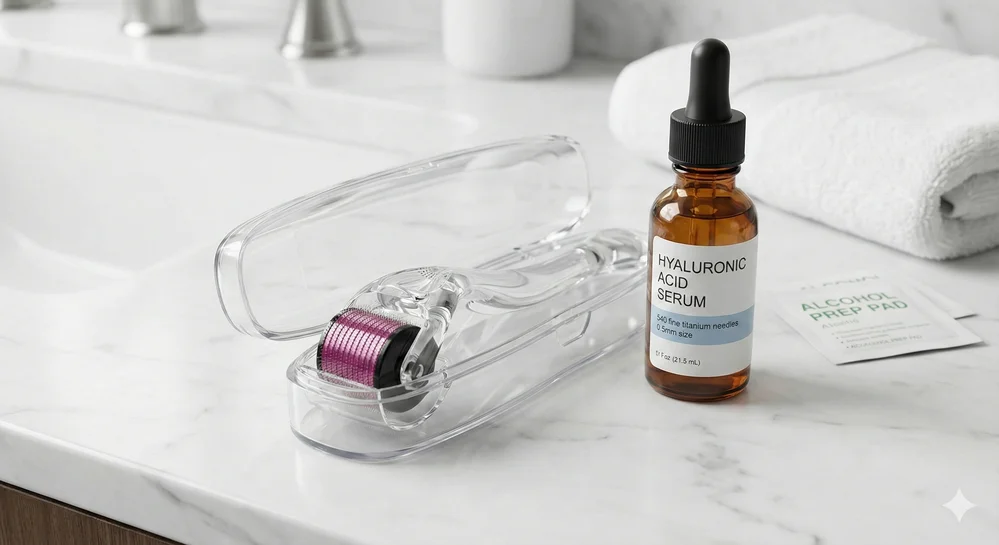
For home use on the face and beard, the standard is 0.5 mm.
Under 0.5 mm: only improves absorption of creams; it does not stimulate collagen.
Over 0.75 mm: dangerous. Longer needles (1.0 mm or 1.5 mm) should be used EXCLUSIVELY by professionals in a clinic. Using them at home increases the risk of nerve damage and scarring.
You are opening your skin. If the roller is not sterile, you are introducing bacteria straight into your dermis.
Before use: soak the roller head in 70% alcohol for 10 minutes and let it air dry. Wash your face thoroughly.
After use: disinfect again with alcohol and store it in its case.
One more thing: never share your dermaroller. It is like sharing a toothbrush, but with blood involved.
Skin needs time to heal and produce collagen. Rolling every day keeps it in a constant state of inflammation.
Recommended frequency: once a week, or twice at most if your skin is already used to it.
You are not ploughing a field. Let the needles do the work. Roll gently in an asterisk pattern — vertical, horizontal and diagonal — around four or five times per area. If you bleed beyond a few tiny points, you are pressing too hard.
This is the question everyone asks. Many people want to use the roller to open channels so minoxidil penetrates further.
The medical warning: if you apply minoxidil immediately after rolling, the drug enters the bloodstream directly through the micro-wounds, sharply increasing the risk of systemic side effects — raised heart rate, dizziness, headache.
The right way: use the dermaroller one day and wait at least 24 hours before applying minoxidil to that area. Let the micro-channels close first.
The dermaroller is an excellent accelerator for experienced users who are disciplined about hygiene. If you are careless with it, you are better off not using it at all.
Remember that a roller does not create follicles where there are none. It is a stimulant. If your problem is advanced alopecia or areas with no hair at all, you need a professional assessment.
Not sure whether your skin is suited to microneedling?
Get advice before you start needling your skin.
Stress-Related Hair Loss: The Quiet Epidemic of the Digital Age 😰📱 Stress-related hair loss is an increasingly common condition in our hyper-connected society. It can appear as temporary shedding or even trigger more serious forms of alopecia. But what causes it, who does it affect most, and how does the digital age contribute? Read on […]
💊 What Is Finasteride Used For in Women? Finasteride is widely known for treating androgenetic alopecia in men. In recent years, however, its use in women has attracted considerable interest, particularly among those dealing with hair loss. So what is finasteride used for in women? 💁♀️ This article covers how it works, its benefits, the […]
✔ A professional, personalised diagnosis Proper hair care does more than improve how your hair looks — it prevents shedding, breakage and loss of density. Choosing the right treatment depends on your needs and the current condition of your hair 💇♂️. This article covers the most effective hair treatments, backed by trichologists, for hair that […]
Date:
Time:
Location:
You will get the appointment confirmation on WhatsApp at the number ending in to sort out the details and answer any questions
Enter your number and we'll send you a code via SMS and WhatsApp.
Enter the code we sent to via SMS and WhatsApp.
Your number isn't registered yet. Fill in your details to create your account.
Have questions?