
Date:
Time:
Location:


 Hair Restoration
Why Is My Hairline Receding? Effective Treatments to Bring It Back
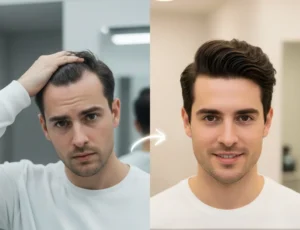 If you look in the mirror and notice that your hairline at the temples and forehead seems to be moving back, you are far from alone. A receding hairline is one of the most common reasons people seek help for their hair. Beyond the cosmetic concern, it is a signal that something is happening to your hair health.
The key to stopping and reversing the process is not to disguise it, but to understand what is causing it. In this article we look at the main causes of a receding hairline and the most effective treatments — from topical solutions to advanced procedures — so you can restore both density and confidence.
Hair loss that shows up as a receding hairline has multiple possible causes. Identifying which one applies to you is the first and most important step towards a solution.
The most common cause, particularly in men, is androgenetic alopecia (AGA).
What it is: a genetic condition. If your father, grandfather or uncles have a similar pattern of loss, there is a good chance you will develop it too.
The hormonal process: in genetically predisposed people, testosterone converts into dihydrotestosterone (DHT). This potent androgen binds to the hair follicles, miniaturises them and shortens the growth (anagen) phase until the hair becomes fine, almost invisible, and eventually stops growing. In men this typically produces the classic “M” shape or a markedly receded hairline. In women it is less common at the temples and instead appears as generalised thinning.
A very common and, fortunately, reversible cause is telogen effluvium.
Triggers: periods of severe stress, a serious illness (such as COVID-19), surgery, post-partum hormonal changes or nutritional deficiencies — mainly iron, zinc or vitamin D.
The effect: stress pushes a large number of follicles into their resting (telogen) phase prematurely. Two or three months after the stressful event the hair sheds heavily, which can noticeably widen a receding hairline.
Sometimes the problem is self-inflicted through the way we treat our hair.
Tight hairstyles: braids, ponytails or buns pulled tightly and constantly at the front hairline can cause traction alopecia.
The damage: chronic tension damages and inflames the follicles, and can cause permanent loss if the habit is not corrected in time.
Once the cause has been identified, treatment can be targeted — and far more effective.
These are the first line of defence for most types of alopecia.
Minoxidil: the best known and approved topical treatment. It acts as a vasodilator, improving blood flow to the hair follicle, which extends the growth phase and often halts shedding while promoting new growth. It is applied directly to the receding areas.
Shampoos and lotions with growth factors: as a complement, products containing specific peptides or botanical extracts can help stimulate the scalp and improve follicle health.
For androgenetic alopecia, oral medication is often the most powerful option.
Finasteride / dutasteride: these drugs inhibit the enzyme that converts testosterone into DHT, lowering levels of the damaging hormone and allowing miniaturised follicles to recover their size. They are highly effective, but must be prescribed and monitored by a dermatologist or trichologist.
Performed at specialist clinics, these procedures stimulate the follicles directly.
Platelet-rich plasma (PRP): a small blood sample is taken from the patient, processed to concentrate the platelets — which are rich in growth factors — and then injected into the scalp. This revitalises existing follicles and boosts growth.
Hair mesotherapy: a mixture of vitamins, amino acids and medication is injected into the middle layer of the scalp (the dermis) to nourish and stimulate the follicle.
When the hairline has receded considerably and the loss is permanent, a hair transplant is the only remaining solution.
FUE (Follicular Unit Extraction): the most widely used method. Follicles are taken from the donor area — usually the nape, which is genetically resistant to loss — and implanted one by one along the hairline and temples. The procedure delivers permanent, natural results.
No treatment reaches its full potential without support from your daily routine.
A balanced diet: make sure you are getting enough protein, iron (red meat, pulses), biotin (nuts, eggs) and omega-3 fatty acids.
Managing stress: yoga, meditation or regular exercise are all important in reducing telogen effluvium.
Gentle care: avoid hairstyles that pull on the hair, and limit excessive heat.
A receding hairline is not a life sentence. With the right intervention it is possible to halt hair loss and stimulate new growth. Topical and oral treatments can stop androgenetic alopecia, while a hair transplant is the most effective way to restore density that has already been lost.
The key is acting early. If you have noticed a recent increase in shedding or that your hairline is moving back, get a diagnosis from a specialist — a dermatologist or trichologist. They can determine the exact cause and build an effective, personalised treatment plan so you recover not just your hair but your confidence.
Do not let worrying about your hairline take over your day.
At Rogans you can book a detailed professional assessment — by video call from anywhere — and start your personalised treatment plan straight away, or plan a hair transplant using the most advanced techniques.
Take the first step towards restoring your hair.
Stress-Related Hair Loss: The Quiet Epidemic of the Digital Age 😰📱 Stress-related hair loss is an increasingly common condition in our hyper-connected society. It can appear as temporary shedding or even trigger more serious forms of alopecia. But what causes it, who does it affect most, and how does the digital age contribute? Read on […]
💇♀️ Noticing more hair falling than usual? Find out which doctor is right for your type of hair loss and start restoring your hair health. Doctors for Hair Loss: Which Specialist Should You See? Hair loss affects men and women alike and can have many causes. From general thinning through to alopecia, identifying the right […]
Foods for Healthy Hair: The Vitamins That Strengthen the Follicle By: the Rogans medical team Reading time: 4 minutes When hair starts losing strength or shine, the first thing most people do is change shampoo. At Rogans we always remind patients of a fundamental biological fact: hair is nourished from the inside. Your hair is […]
Date:
Time:
Location:
You will get the appointment confirmation on WhatsApp at the number ending in to sort out the details and answer any questions
Enter your number and we'll send you a code via SMS and WhatsApp.
Enter the code we sent to via SMS and WhatsApp.
Your number isn't registered yet. Fill in your details to create your account.
Have questions?