
Date:
Time:
Location:


 Hair Restoration
Last updated: 2026.
Alopecia areata is one of the most visible and bewildering forms of hair loss: round patches that appear from one day to the next, with no warning. It is an autoimmune condition in which the body’s defence system mistakenly attacks the hair follicles, halting hair growth. It affects roughly 2% of the world’s population at some point in life and can appear at any age, though it is most common between 15 and 35. In this medical guide from Rogans we explain what alopecia areata is, why it appears, how to distinguish it from other forms of hair loss and which medical treatments work today. If you have spent weeks noticing bare patches and want to rule out serious causes, this article is for you.
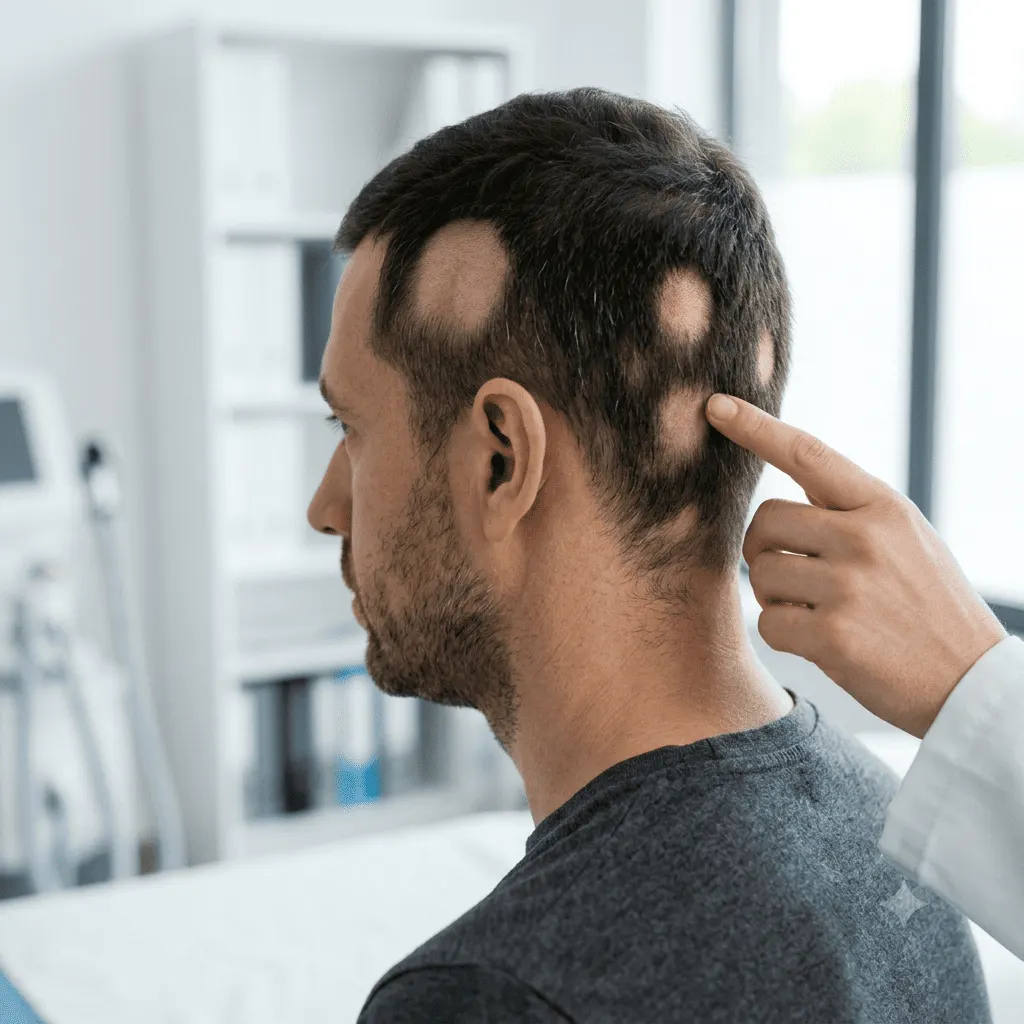
Alopecia areata is a chronic autoimmune condition that appears as hair loss in well-defined patches, usually round or oval. Unlike androgenetic alopecia — common baldness — there is no progressive miniaturisation of the follicle: the hair simply stops growing in one area and the skin is left smooth. The scalp in those areas usually looks normal, with no redness or flaking. The condition is not contagious, is painless in most cases and, although emotionally difficult, frequently resolves on its own with or without treatment.
There are more extensive forms: alopecia totalis (complete loss of scalp hair) and alopecia universalis (loss of all body hair, including eyebrows, eyelashes and pubic hair). These are less common but harder to treat. A trichology consultation is the first step towards confirming the diagnosis and deciding on a course of treatment.
The exact cause of alopecia areata is still under investigation, but the evidence points to a combination of genetic predisposition and immune dysregulation. The immune system attacks the hair follicle, mistaking it for an invader, which interrupts the anagen (growth) phase and pushes the follicle into a prolonged resting state. The good news is that the follicle is not destroyed, so hair can grow back once the immune attack stops.
Known risk factors include a family history of autoimmune disease (vitiligo, Hashimoto’s thyroiditis, lupus, type 1 diabetes), severe emotional stress, viral infections and certain hormonal changes. At Rogans we assess each case comprehensively: alongside the trichological examination we request a thyroid profile, vitamin D, iron and other markers that can drive an autoimmune response.
The most characteristic presentation is one or more round, bare patches on the scalp, roughly the size of a coin. The skin looks smooth and uninflamed. Other signs include “exclamation mark” hairs — short, thin at the base and wider towards the tip — small pitted depressions in the nails (nail pitting), and a mild tingling or burning sensation before the patch appears.
When the patches affect the temporal and occipital areas in a band, it is called ophiasis alopecia, a pattern that is harder to treat. When there is rapid, diffuse loss of all the hair over a few weeks, it is known as alopecia areata incognita, which can be mistaken for telogen effluvium. This is precisely why a professional medical diagnosis matters.
How the condition presents affects the prognosis. Small, isolated patches have a high chance of spontaneous remission — up to 80% within the first year — while more extensive forms require active medical treatment.
Diagnosing alopecia areata is fundamentally clinical: a trained trichologist can identify it in consultation by examining the scalp and using hair dermatoscopy. At a Rogans hair consultation we carry out:
Taking an online hair diagnosis is a useful first filter for understanding which type of alopecia you may have before an in-person consultation.
Treatments for alopecia areata aim to halt the immune attack and stimulate growth. The choice depends on how extensive the condition is, the patient’s age and how long it has been developing.
This is the first-line treatment for localised patches. Triamcinolone injections are applied directly into the scalp every four to six weeks. Effectiveness is high when the affected area is limited and the disease is active.
For more extensive forms, agents such as diphencyprone (DCP) are used to provoke a controlled dermatitis that “distracts” the immune system. It calls for patience and consistency: results appear from the third month onwards.
Minoxidil does not address the autoimmune cause, but it can speed recovery once the follicle regains activity. It is applied twice daily, with visible results at three to six months. Read our guide to using minoxidil safely.
The therapeutic breakthrough of recent years: Janus kinase inhibitors (baricitinib, ritlecitinib) have shown notable results in severe alopecia areata, with significant hair recovery in more than 30% of patients after 36 weeks of treatment. Their use requires strict medical monitoring.
The most frequent question is: can I have a hair transplant if I have alopecia areata? The short answer is: only in very specific cases. FUE transplantation is designed for stable alopecias — particularly androgenetic — where the cause of the loss is well controlled. In active alopecia areata the immune system may also attack the transplanted follicles, compromising the result.
That said, in patients whose alopecia areata has been stable for at least two to three years, with no new flare-ups and clearly defined affected areas, a transplant can be a valid option. Every case requires individual assessment by a trichologist and a dermatologist. At Rogans we carry out rigorous prior studies before proposing any surgical procedure.
Yes — up to 50% of patients may relapse in subsequent years. That is why ongoing medical follow-up matters, even during remission.
Stress is not the cause, but it can act as a trigger in people with a genetic and immunological predisposition.
There is no solid scientific evidence supporting natural treatments as a sole therapy. They may complement medical management but cannot replace it.
Alopecia areata calls for an individualised medical approach and, above all, a timely one. The sooner treatment begins, the greater the likelihood of a response. At Rogans, a team of trichologists with more than 30 years of experience assesses your case, defines the right treatment plan and supports you with follow-up through our private medical app — which means your treatment can continue from wherever you are. Don’t wait for the patches to spread: a timely consultation can change the outlook for your hair.
Thinning Crown: The First Warning Sign and How to Restore Density The Crown: A Blind Spot in Hair Loss A thinning crown — the area at the top and back of the head — is for many people the first and clearest sign that alopecia is progressing. The thinning usually starts subtly and is […]
What Is DHI Hair Transplantation? Hair restoration has moved on quickly from the older techniques that produced obviously artificial results. Today the focus is on precision, natural appearance and a faster recovery for the patient. At the leading edge of that shift is DHI — Direct Hair Implantation — a method that has changed how […]
✨ The Hair Growth Cycle: How Hair Grows and Why It Falls Worried about hair loss? 💭 Before making hasty decisions about treatments, it helps to understand how the hair life cycle works. Knowing the phases of hair growth explains why losing a certain amount every day is normal — and when it may signal […]
Date:
Time:
Location:
You will get the appointment confirmation on WhatsApp at the number ending in to sort out the details and answer any questions
Enter your number and we'll send you a code via SMS and WhatsApp.
Enter the code we sent to via SMS and WhatsApp.
Your number isn't registered yet. Fill in your details to create your account.
Have questions?