
Date:
Time:
Location:


 Hair Restoration
Thinning Crown: The First Warning Sign and How to Restore Density
 The Crown: A Blind Spot in Hair Loss
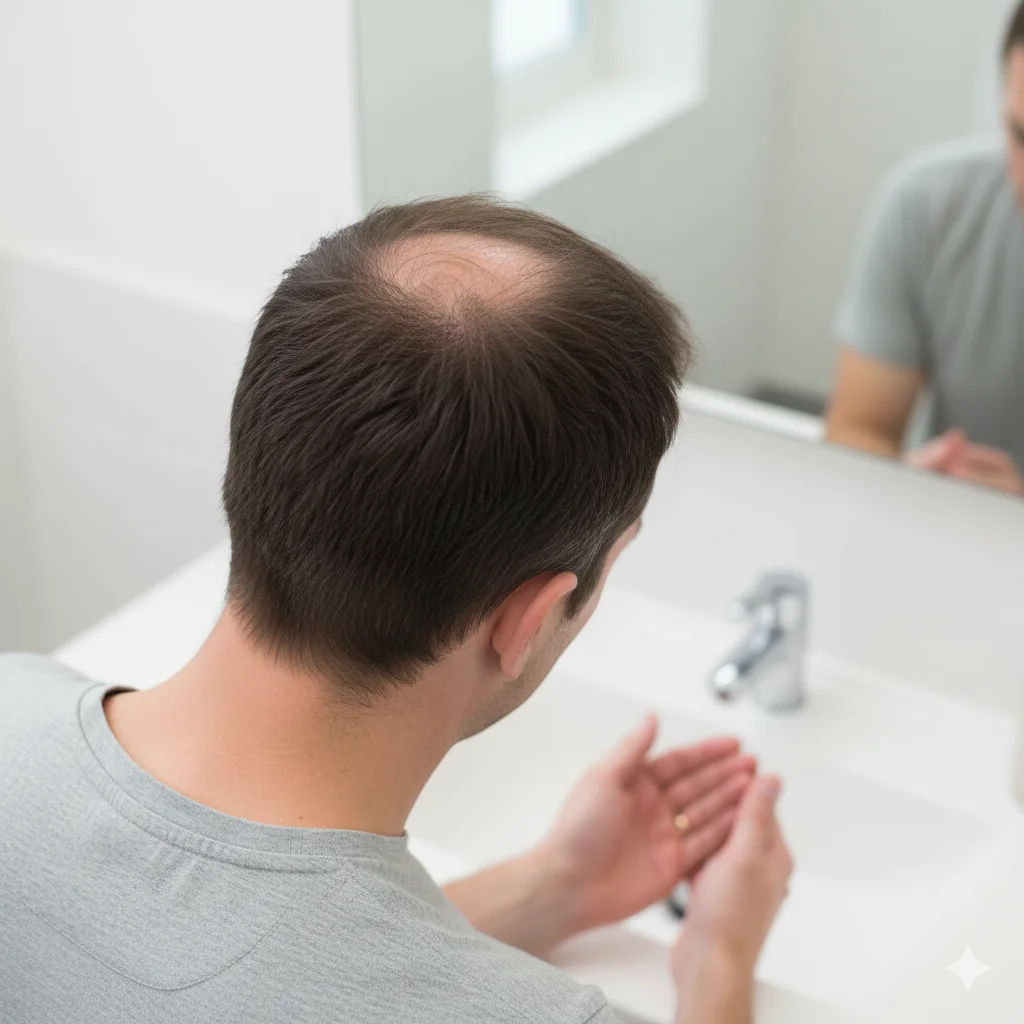
A thinning crown — the area at the top and back of the head — is for many people the first and clearest sign that alopecia is progressing. The thinning usually starts subtly and is hard to spot early, simply because it is difficult to see that part of your own head. But if the hair at your crown looks finer, if the scalp becomes visible under certain lighting, or if you have gone from needing one strand to needing a great deal of hair to cover the area, it is time to act.
This pattern is the classic warning sign of androgenetic alopecia (male pattern baldness), the most common cause of permanent hair loss. Understanding why it happens and how to tackle it is crucial to restoring hair density before the process becomes irreversible.
The main reason the crown is one of the first areas to lose hair is both biological and genetic.
Androgenetic alopecia is behind the vast majority of cases of a thinning crown. The condition is hereditary and appears when hair follicles are hypersensitive to dihydrotestosterone (DHT), a derivative of testosterone.
Progressive miniaturisation: DHT binds to receptors in the follicles at the crown and temples, starting a process called miniaturisation. With each growth cycle the follicle shrinks.
Finer, shorter hair: the hair produced becomes progressively finer, shorter and less pigmented, losing its strength and density. What looks like a crown with low density is in fact made up of miniaturised hairs.
A prolonged resting phase: eventually the follicle enters a permanent resting phase or disappears altogether, leaving the area completely bare.
It is worth noting that the follicles at the nape and sides of the head are generally not sensitive to DHT, which is why those areas keep their hair — and why they serve as the donor area in hair transplant procedures.
Since the crown is hard to see, you need to watch for other warning signs:
| Indicator | Description |
| The “spotlight effect” | Under bright or overhead lighting, the scalp becomes noticeably reflective and visible. |
| Styling to cover up | You need more time and more product to style your hair in a way that hides the crown. |
| Changes in texture | The hair at the crown feels softer, finer and less robust to the touch than the hair at the sides. |
| How it looks when wet | After swimming or a shower, the crown looks almost transparent or bald. |
If you recognise any of these signs, hair density in that area has already begun to decline — and this is the ideal moment to intervene.
The key to restoring density at the crown is acting quickly: treatments are far more effective while the follicle is still miniaturised and has not died completely.
These are the scientifically proven first-line treatments for halting the miniaturisation caused by DHT:
Finasteride (oral): it works by inhibiting the 5-alpha-reductase enzyme, which converts testosterone into DHT. By lowering DHT levels it halts miniaturisation and in many cases reverses the process, allowing the follicle to produce thick hair again. It is used primarily for male androgenetic alopecia.
Minoxidil (topical): it does not block DHT, but it is a vasodilator that extends the growth (anagen) phase and stimulates blood flow to the follicles. It is effective at improving density and overall hair health at the crown.
Platelet-rich plasma (PRP): this treatment involves injecting the patient’s own plasma, enriched with growth factors, directly into the scalp. It helps stimulate weakened follicles, improving the quality and density of existing hair.
When the crown is completely bare and the follicles have died (advanced alopecia), medication can only preserve the hair that remains.
FUE (Follicular Unit Extraction): the most effective solution in these cases. Healthy, DHT-resistant follicles are transplanted from the nape to the bare area of the crown. That transplanted hair grows permanently.
Making sure you get enough biotin, zinc, iron and B vitamins can support hair health and complement the main treatments — though on their own they rarely reverse advanced androgenetic alopecia.
If a thinning crown has become a concern, the best strategy is immediate action. The sooner you begin treatment against DHT or start biostimulation, the better your chances of restoring density and preventing further baldness. Do not underestimate early detection: it is the difference between halting the process and having to resort to a more invasive solution.
At Rogans we specialise in the diagnosis and advanced treatment of hair loss at every stage. We can determine how far miniaturisation has progressed at your crown and build a personalised treatment plan, whether medical or surgical.
Book an assessment today — by video call from anywhere — and start working towards stronger, denser hair.
It hurts to brush your hair, to tie it back, even to touch your head gently. Scalp pain and tenderness are more common than people realise and, while often mild, they can sometimes signal something worth looking into — particularly when they come alongside hair loss. This guide covers why the scalp hurts, what causes […]
Hair Loss in Young People: Is It Normal to Lose Hair at 20? The worry that hits a younger generation Hair loss has traditionally been associated with middle age. Today, though, it is a growing concern among young men and women in their 20s and 30s. Watching your brush fill with hair, or noticing […]
A hair transplant in Colombia is one of the most sought-after treatments among men and women who want to restore their hair naturally — and one of the main reasons international patients travel here. In this complete guide you will learn how much a hair transplant costs in Colombia, which factors affect the price, how […]
Date:
Time:
Location:
You will get the appointment confirmation on WhatsApp at the number ending in to sort out the details and answer any questions
Enter your number and we'll send you a code via SMS and WhatsApp.
Enter the code we sent to via SMS and WhatsApp.
Your number isn't registered yet. Fill in your details to create your account.
Have questions?