
Date:
Time:
Location:


 Hair Restoration
Androgenetic Alopecia in Men
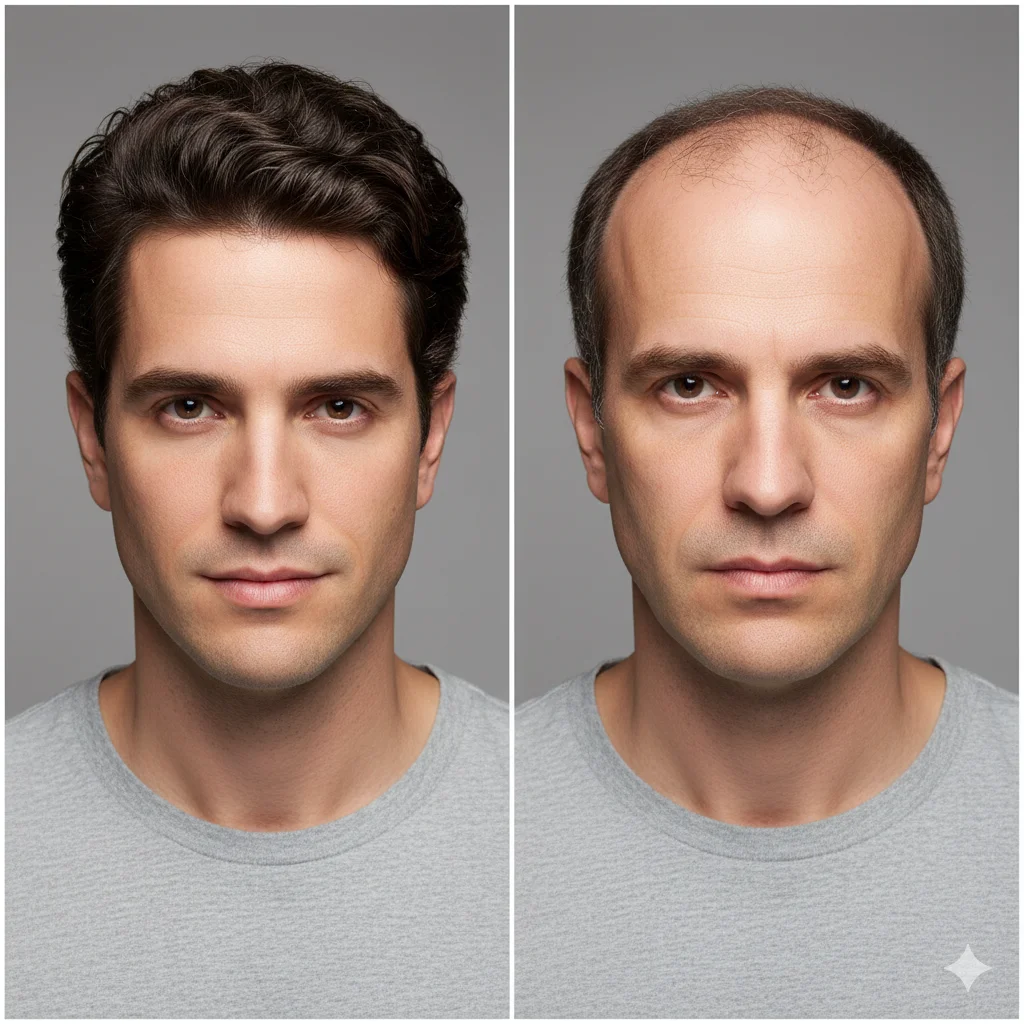
 Androgenetic alopecia (AGA), commonly known as male pattern baldness, is the most common form of hair loss in men. It affects a large proportion of the male population, often beginning in the late teens or early twenties and progressing over time. For many men, noticing a receding hairline or thinning at the crown is a significant worry.
Not all hair loss is androgenetic alopecia, though. It is important to know how to tell it apart from stress-related hair loss and other temporary causes, because the treatments are completely different. This article walks through the biological causes of AGA, its characteristic symptoms and how to distinguish it from telogen effluvium.
Androgenetic alopecia is not a disease but a genetic predisposition. Despite the name, two factors have to coincide for it to appear:
Heredity plays a key role. If you have male relatives — particularly your father, uncles or grandfathers — with baldness, your chances of developing AGA are significantly higher. The inheritance pattern is complex, but genetics is the main driver.
This is the chemical culprit. Testosterone is converted into dihydrotestosterone (DHT) by the 5-alpha-reductase enzyme. DHT is an extremely potent androgen.
In genetically predisposed men, the hair follicles in certain areas — the temples and the crown — are hypersensitive to DHT.
Miniaturisation: on exposure to DHT, these follicles progressively shrink, a process known as follicular miniaturisation.
Weaker hair: with each growth cycle the hair becomes finer, shorter and weaker, losing the density it once had.
Baldness: eventually the follicle enters a permanent resting phase, resulting in complete hair loss in that area. The process is chronic and progressive.
AGA follows a very specific pattern, classified clinically using the Norwood-Hamilton Scale. The most common symptoms are:
The hair begins to recede symmetrically on both sides of the forehead, forming the characteristic “M” or horseshoe shape. These recessions become more pronounced over time.
This is the blind spot. Hair at the top and back of the head starts losing density, becoming fine and leaving the scalp visible under certain lighting.
In the affected areas the hair does not simply fall — its quality changes. The hairs feel soft and lack body, a clear sign that miniaturisation is under way.
Progression is slow and gradual: it does not happen overnight, but over months and years.
This is the key question. Confusing AGA with temporary stress-related loss (telogen effluvium) leads to ineffective treatment.
| Characteristic | Androgenetic alopecia (AGA) | Telogen effluvium (stress) |
| Root cause | Genetics and sensitivity to DHT. | A triggering event (stress, illness, diet). |
| Pattern of loss | Specific: temples and crown (M or horseshoe). | Diffuse: uniform, generalised loss across the whole head. |
| Speed | Slow and progressive (years). | Fast and intense — very noticeable in the brush and the shower. |
| Hair that falls | Fine, miniaturised hairs. | Thick, healthy hairs that have stopped growing. |
| Reversibility | Not reversible without treatment. It is chronic. | Reversible once the source of stress is removed. |
| Timing | Continuous. | Occurs 2–4 months after the stressful event. |
If your loss is concentrated at the temples and crown and you have noticed the hair quality declining over several months, AGA is the likely explanation. If the loss is sudden, heavy and spread across the whole head, stress is the more probable cause.
Because AGA is chronic and driven by hormonal action, treatment has to be continuous and targeted at DHT.
DHT blockers (finasteride): finasteride is the most effective oral treatment for men. It inhibits the 5-alpha-reductase enzyme, significantly reducing DHT levels in the scalp and the body, which halts miniaturisation and can reverse it.
Growth stimulants (minoxidil): minoxidil, topical or oral, stimulates circulation and extends the follicle’s growth phase, helping miniaturised hairs regain thickness.
Hair therapy: treatments such as platelet-rich plasma (PRP) or hair mesotherapy can complement the above by biostimulating weakened follicles.
Hair transplant: for areas that are already bald, where the follicles have died, an FUE transplant is the only definitive way to restore density.
Understanding the causes, symptoms and patterns of androgenetic alopecia is the first and most important step. If you notice your hairline or crown receding, do not put it down to stress alone. The key to keeping your hair with AGA is an early professional diagnosis, so treatment to block DHT can begin before miniaturisation becomes irreversible.
At Rogans we specialise in the precise diagnosis and treatment of androgenetic alopecia and telogen effluvium. We use advanced technology to confirm the cause of your hair loss and design an effective, personalised treatment plan.
💇♂️ Is a Hair Transplant Worth It? Hair loss affects men and women at different stages of life, and the causes vary: genetics, hormones, stress, diet or illness can all play a part. Whatever the reason, losing hair has both a cosmetic and an emotional impact, affecting confidence and the way we relate to other […]
Hair loss and aging skin have something in common: the cells that should keep repairing the tissue slow down. Exosome therapy is one of the newest approaches in regenerative medicine to support that repair, and it is drawing a lot of attention for both hair loss and skin rejuvenation. Here is what exosomes are, how […]
💇♀️ Hair and Scalp Conditions: Causes, Treatments and Prevention The health of your hair is a direct reflection of your general wellbeing. There are, however, a number of hair and scalp conditions that affect its appearance, texture and growth 🧠. Recognising them, understanding their causes and knowing how to treat them is essential to keeping […]
Date:
Time:
Location:
You will get the appointment confirmation on WhatsApp at the number ending in to sort out the details and answer any questions
Enter your number and we'll send you a code via SMS and WhatsApp.
Enter the code we sent to via SMS and WhatsApp.
Your number isn't registered yet. Fill in your details to create your account.
Have questions?