
Date:
Time:
Location:


 Hair Restoration
By: the Rogans medical team Reading time: 4 minutes
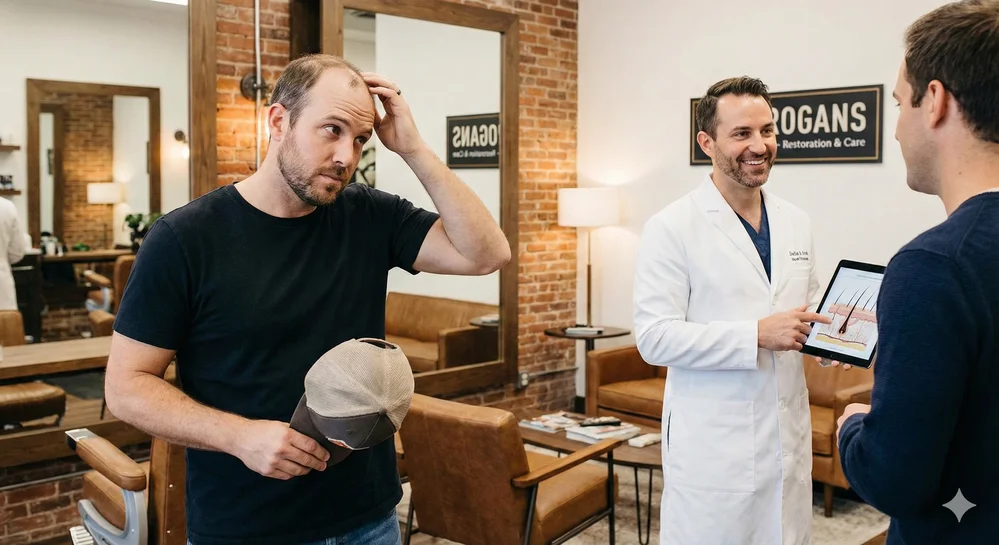
It is one of the questions we hear most often at a first consultation. A patient arrives worried, eyeing their favourite cap with suspicion, convinced that this everyday accessory is behind the receding hairline they see in the mirror.
If you have wondered whether wearing a hat “suffocates” your hair or speeds up its loss, you are not alone. Let’s set the fear aside and talk science and honesty. Misinformation can be as damaging as no treatment at all, and our aim is for you to make decisions based on medical reality rather than urban myth.
The short answer is no.
To understand why, you need to know how hair is fed. Unlike a plant, your hair does not need to “breathe” outside air to grow. The hair follicles receive the oxygen and nutrients they need through the bloodstream in the scalp.
So wearing a cap, hat or helmet does not cut off the oxygen supply to the root. Common baldness, known medically as androgenetic alopecia, is an internal process determined by your genetics and your hormones — not by what you put on your head.
There is an important caveat, though: wearing hats can affect hair health in two specific situations. Neither is genetic baldness, but both deserve attention:
The Rogans advice: wear your cap freely, but keep it clean and don’t tighten it to the point of leaving a mark on your forehead.
With the cap acquitted, let’s deal with a few other imaginary villains that confuse our patients.
False. Washing is necessary to remove the excess oil (sebum) that can block the follicle. The hair you see in the shower was already in its shedding (telogen) phase and would have fallen anyway. Hygiene matters — your scalp is skin and needs cleaning, much like a daily facial routine prevents acne.
False, with a nuance. Styling products do not penetrate to the root and kill it. That said, poor-quality products or those high in alcohol can dry out the hair fibre, causing it to break — not to fall from the root. The key is washing your hair properly at the end of the day.
False. Hair thickness is determined by your genetics and follicle health. Cutting removes the fine tip and leaves the thicker base exposed, which creates an optical illusion of density — but biologically the hair is unchanged.
If the cap is not to blame, what is happening? In the large majority of cases in men — and a growing proportion in women — the cause is androgenetic alopecia.
This occurs when a hormone called dihydrotestosterone (DHT) attacks genetically predisposed hair follicles, making them progressively finer and weaker until they stop producing hair.
At Rogans we do not believe in miracles — we believe in medicine. Depending on the degree of your alopecia, there are proven routes:
Giving up your cap will not stop your alopecia if the cause is genetic. What stops baldness progressing is an early diagnosis and a personalised medical plan.
At Rogans we have made that process simple. There is no need to guess or spend money on home remedies.
Want to know the real state of your hair health in under two minutes?
We will review your case and a specialist will tell you honestly whether you need treatment, a transplant, or simply a different shampoo.
Creatine and Hair Loss: Is the Gym Making You Bald? The worry that follows you into the gym: performance vs hair If you are looking to improve your athletic performance, there is a good chance you have considered — or are already taking — creatine, one of the most studied and effective supplements for building […]
Minoxidil Side Effects: The Myths About Libido and Sexual Health By: the Rogans medical team Reading time: 5 minutes Let’s be direct. When a man starts noticing hair loss and searches for solutions online, he usually comes across two names: minoxidil and finasteride. And almost immediately afterwards, he runs into forum horror stories about lost […]
🧔♂️ Beard Transplant: Redefine Your Look and Your Confidence A beard has become a symbol of masculinity, style and self-assurance. Not every man, however, can grow one that is full or even 😕. If you have patchy areas or simply want a more defined beard, a beard transplant is the most effective and natural solution […]
Date:
Time:
Location:
You will get the appointment confirmation on WhatsApp at the number ending in to sort out the details and answer any questions
Enter your number and we'll send you a code via SMS and WhatsApp.
Enter the code we sent to via SMS and WhatsApp.
Your number isn't registered yet. Fill in your details to create your account.
Have questions?