
Date:
Time:
Location:


 Hair Restoration
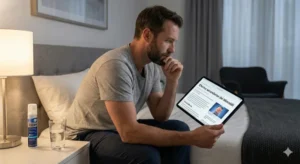
By: the Rogans medical team Reading time: 5 minutes
Let’s be direct. When a man starts noticing hair loss and searches for solutions online, he usually comes across two names: minoxidil and finasteride. And almost immediately afterwards, he runs into forum horror stories about lost libido and erectile dysfunction.
That fear is understandable. At Rogans we recognise that your sexual health matters as much as your hair — if not more. Nobody wants to get their hair back at the cost of their intimate life.
Here is the good news, and it is backed by science: the fear you have is almost certainly aimed at the wrong medication.
To understand the side effects, you first have to separate the two main hair loss treatments. They are different drugs that work in completely different ways:
Finasteride (and dutasteride): these are antiandrogens. They work by blocking the conversion of testosterone into DHT, the hormone that attacks the follicle. Because they act on the hormonal system, a small percentage of patients — between 1% and 3% — may report changes in libido.
Minoxidil: this is a vasodilator. It does not block hormones and does not alter your testosterone. Its job is to widen the blood vessels around the follicle so that more nutrients and oxygen reach it.
The medical verdict: minoxidil on its own has NO direct relationship with erectile dysfunction or loss of libido. It does not affect the male hormonal axis. The myth was born from confusing the two treatments.
At Rogans transparency is the rule. Claiming a medication has no side effects at all would simply be untrue. Minoxidil is very safe and available over the counter in many concentrations, but there are effects you should know about so they do not alarm you:
This is the effect that frightens people most and yet, paradoxically, it is the clearest sign the treatment is working. During the first weeks of use you may notice more hair falling. Do not panic. Minoxidil is accelerating the hair cycle, pushing out old, weak hair to make way for new, stronger growth. It is temporary and necessary.
Particularly with the liquid (topical) version, the alcohol in the product can dry out the scalp, causing dandruff or itching.
The fix: switch to a foam version, use a gentle shampoo, or speak to our specialists about adjusting the dose.
If minoxidil regularly comes into contact with other areas of skin — the forehead, or near the eyebrows — hair can start growing there.
The fix: apply carefully and wash your hands afterwards.
Because it is a vasodilator, in rare cases — or if the recommended dose is exceeded — it can cause a slight drop in blood pressure or a headache.
Oral minoxidil, in tablet form, has recently become popular for its convenience. Because it is systemic, patients ask the same question again: “Does this one affect my sexual function?”
The answer is still no. The mechanism remains vascular, not hormonal. That said, taken orally it is essential to do so under medical supervision — as we provide at Rogans — so the dose can be controlled and cardiovascular health monitored. Your intimate life is not at risk.
Hair loss advances while you hesitate. Many men lose the chance to save their hair because they fear a side effect that, in minoxidil’s case, is an urban myth.
The sensible approach is neither self-medicating nor avoiding treatment altogether, but getting a personalised medical diagnosis. You may only need minoxidil; you may need a vitamin complex; or you may be a candidate for a hair transplant.
Don’t guess with your health. Let the doctors guide you.
Want to know which treatment is safe for you, without compromising your wellbeing?
Confidential, quick and reviewed by specialists.
🧬 At What Age Does Hair Loss Start? Two Factors That Decide It 💇♂️ Hair loss worries a great many people. Some notice their hair thinning over time; others watch a hairline recede or bare patches appear. But at what age does hair loss actually start? 🤔 This article explains when the process usually begins, […]
💊 What Is Finasteride Used For in Women? Finasteride is widely known for treating androgenetic alopecia in men. In recent years, however, its use in women has attracted considerable interest, particularly among those dealing with hair loss. So what is finasteride used for in women? 💁♀️ This article covers how it works, its benefits, the […]
Facial Dermaroller: How to Use It Safely for Beard Growth and Skin By: the Rogans medical team Reading time: 6 minutes You have almost certainly seen the videos: people running a needle-covered roller across their face, promising flawless skin or a viking beard. It looks like medieval torture, but there is a proven dermatological technique […]
Date:
Time:
Location:
You will get the appointment confirmation on WhatsApp at the number ending in to sort out the details and answer any questions
Enter your number and we'll send you a code via SMS and WhatsApp.
Enter the code we sent to via SMS and WhatsApp.
Your number isn't registered yet. Fill in your details to create your account.
Have questions?