
Date:
Time:
Location:


 Hair Restoration
Norwood Scale
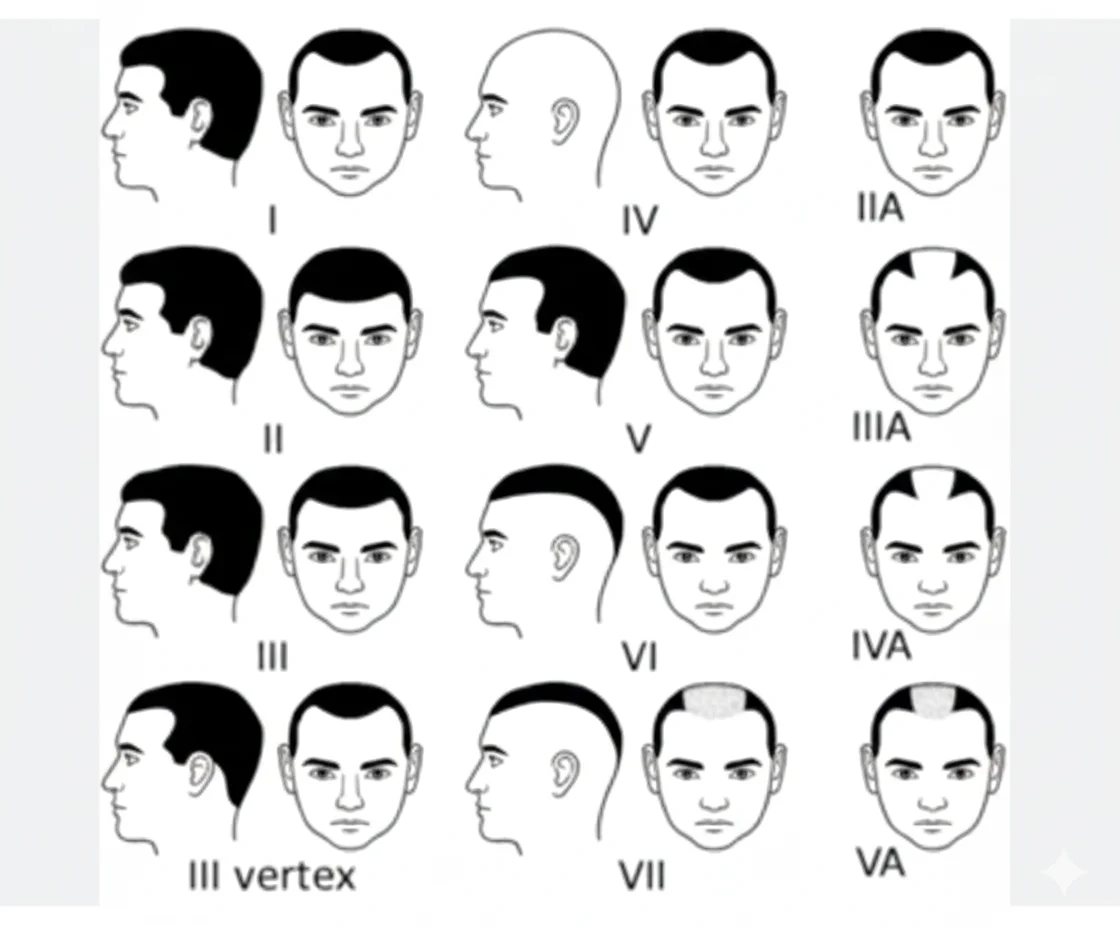
The Norwood-Hamilton Scale is a visual classification system covering seven main stages of hair loss in men. It was developed by Dr James Hamilton in 1951 and later revised by Dr O’Tar Norwood in 1975.
A shared language: it allows precise communication between specialists and patients. Saying “my hairline is receding” is not the same as saying “I am a Norwood Type III”.
Prognosis: it helps predict how the hair loss will progress if left untreated.
Treatment planning: it is essential for deciding whether a patient is suited to medical treatment (minoxidil, finasteride) or needs a hair transplant — and how many follicles that would require.
The scale is divided into seven progressive types, along with some secondary variations.
Norwood Type I: the baseline, or adolescent hairline. There is no significant loss. The hairline is complete or only slightly receded.
Norwood Type II (the first sign): loss is minimal but already visible. The temples recede slightly, forming a mild “M” or “V” shape. This is the ideal moment for prevention.
Recommended approach: low-concentration topical treatment (minoxidil) and vitamin supplements.
Norwood Type III (the threshold of clinical baldness): this is the most important level for diagnosis. The temples are markedly receded and the hairline has moved back significantly. Thinning often begins to appear at the crown (vertex alopecia).
Recommended approach: this is where oral medication (finasteride) becomes crucial to halt progression. It is also the first level at which a hair transplant is a viable option for restoring the frontal hairline.
Norwood Type IV: loss is more severe. The temples recede further and the crown becomes more obvious. The two balding areas remain separated by a band of dense hair connecting the sides.
Norwood Type V: the band of hair separating the frontal and crown areas narrows considerably and becomes finer. Balding is extensive, but hair still remains at the sides and the nape.
Recommended approach: at this point medical treatment works mainly as a stabiliser to prevent further loss. A hair transplant is almost always necessary, and a considerable number of follicles will be needed to cover both areas.
Norwood Type VI: the band of hair separating the two areas disappears entirely. The frontal and crown balding merge into one large bald area.
Norwood Type VII: the most severe form. Only a narrow band of remaining hair persists around the lower part of the head — the classic horseshoe — and at the nape. The density of the donor hair that remains becomes critical.
Consideration: a transplant is still possible, but the surgeon must be highly strategic because the donor area is limited. The frontal hairline is often prioritised and the transplant performed at a lower density.
The Norwood Scale matters because the solution for a Type II is nothing like the solution for a Type VI.
| Norwood level | Severity | Treatment goal | Key options |
| I – II | Minimal (prevention) | Stabilise the pattern. | Topical minoxidil, vitamins and supplements. |
| III – IV | Moderate | Halt progression and fill in affected areas. | Oral finasteride + topical minoxidil. Transplant if you want the frontal hairline restored. |
| V – VI | Advanced | Restore density and coverage. | Hair transplant (FUE) with a large number of follicles, plus ongoing medical stabilisation. |
| VII | Severe (salvage) | Maximise coverage with limited follicles. | Strategic hair transplant. |
You can identify your approximate level on the Norwood Scale yourself, but only a professional diagnosis by a trichologist or hair surgeon will confirm your exact stage. They assess not just the visible pattern but also:
Miniaturisation: the proportion of hairs that have become thinner.
Donor area density: essential for planning any transplant.
Other causes: ruling out other types of alopecia or underlying health issues.
Knowing your Norwood level lets you act with precision. It means starting the right treatment before the loss becomes irreversible or the donor area is compromised. Do not wait until you reach an advanced stage to seek help.
At Rogans you can book a professional assessment to determine your stage on the Norwood-Hamilton Scale and build an action plan — whether that means advanced medical treatment or a hair transplant that restores your hair for good. The initial assessment can be done by video call from anywhere.
Minoxidil Side Effects: The Myths About Libido and Sexual Health By: the Rogans medical team Reading time: 5 minutes Let’s be direct. When a man starts noticing hair loss and searches for solutions online, he usually comes across two names: minoxidil and finasteride. And almost immediately afterwards, he runs into forum horror stories about lost […]
Finding bald patches with irregular shapes, or noticing hair volume drop sharply with no apparent inflammatory cause, is a disconcerting experience. For a significant number of people this loss does not originate in a primary disease of the follicle but in a neuro-cutaneous condition called trichotillomania. If you have wondered what trichotillomania is, it is […]
💇♂️ Is a Hair Transplant Worth It? Hair loss affects men and women at different stages of life, and the causes vary: genetics, hormones, stress, diet or illness can all play a part. Whatever the reason, losing hair has both a cosmetic and an emotional impact, affecting confidence and the way we relate to other […]
Date:
Time:
Location:
You will get the appointment confirmation on WhatsApp at the number ending in to sort out the details and answer any questions
Enter your number and we'll send you a code via SMS and WhatsApp.
Enter the code we sent to via SMS and WhatsApp.
Your number isn't registered yet. Fill in your details to create your account.
Have questions?